SIGGRAPH 2026 Explores the Future of Robotics Through Computer Graphics, Simulation, and Creative Expression

The world's premier conference on computer graphics showcases how the technologies behind film, games, and visual effects are shaping the next generation of robots
LOS ANGELES, July 1, 2026 /PRNewswire/ -- Computer graphics and robotics have been converging for years. At SIGGRAPH 2026, that convergence takes center stage as robots learn, move, create, and interact through technologies originally developed for film, games, and visual effects. Taking place 19–23 July at the Los Angeles Convention Center, the conference shows how advances in computer graphics are helping shape the future of intelligent machines, revealing a future where virtual worlds are increasingly used to train, test, and inspire robotic systems.
At SIGGRAPH 2026, robotics is not confined to a single program. It runs as a common thread across the conference, appearing in Technical Papers, Emerging Technologies, Courses, Frontiers, Spatial Storytelling, Art Papers, Talks, and Technical Workshops. Together, these sessions demonstrate how the same technologies used to create digital characters, immersive worlds, and visual effects are increasingly being used to design, train, and deploy robots capable of operating in complex real-world environments.
"The lines between computer graphics, physics, and AI are blurring. Because of that, you're seeing robotics become more pervasive at the conference because these fields are naturally becoming more intertwined," said SIGGRAPH 2026 Conference Chair Chris Redmann. "It opens up new horizons and pathways for computer graphics research and new modes of interactivity, where the physical world and the digital world become even more complementary."
Training Robots in Virtual Worlds
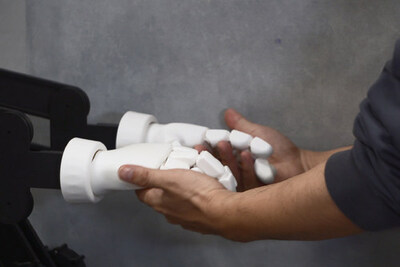
A central theme across this year's robotics programming is simulation-first development, in which robots are designed, trained, and validated in virtual environments before entering the physical world. A trio of NVIDIA-led courses anchors the thread: "How To Build End-To-End Physical AI Systems for Robots" covers data generation, training, and edge deployment for humanoid and general-purpose robots; "Accelerate Robot Learning With NVIDIA Isaac Lab and Newton" introduces a GPU-accelerated physics engine for training and evaluating robot policies; and "Simulating a Dextrous Hand For Robotics With OpenUSD" walks through preparing simulation-ready robot assets.
The same ideas drive a strong Technical Papers showing, where "SimArt: Decomposing Monolithic Meshes into Sim-ready Articulated Assets via MLLM" converts static 3D meshes into simulation-ready articulated assets, "MotionBricks: Scalable Real-Time Motions with Modular Latent Generative Model and Smart Primitives" generates real-time motion for animation and robotics, "ReActor: Reinforcement Learning for Physics-Aware Motion Retargeting" from Disney Research uses reinforcement learning to retarget human motion onto humanoid and quadruped forms, and "Computational Design of Terrestrial Robots with Anisotropic Friction", from teams including Carnegie Mellon University, Genesis AI, Tsinghua University, and Shanghai Qi Zhi Institute, co-designs robot bodies and controllers for locomotion.
Rounding out the thread, the Technical Workshop "Differentiable Physics for Graphics and AI" examines how differentiable simulation is reshaping graphics, robotics, and design, and the Frontiers Workshop "Digital Twins for Science and Industry" looks at how virtual replicas are transforming healthcare, energy, and scientific visualization.
New Modes of Human-Robot Interaction
A second thread, concentrated in the Emerging Technologies program, reimagines how people and robots interact, often in strikingly personal ways. In "Katakko: Embodiment of Modular Robots through Automatic Motion Mapping", attendees assemble communication-oriented modules into a personalized social robot and embody it through an algorithm that maps their own movements onto the machine. "Shall We Dance? Resonance of Intentions with an Embodied Agent based on the Free Energy Principle" introduces an agent that negotiates intentions through physical interaction, synchronizing with a human partner's choreography and tempo in real time.
"Telekinetic Drive: Controlling Robots with Intent-Leaking Micro-Motions" lets participants move a robot arm through intent alone, drawing on the subtle micro-motions the body produces when it prepares to act; while "EmoMime: Augmenting Social Behavior and Self-Expression via Wearable Robotic Limbs" showcases a neck-mounted wearable that amplifies social signals and enables comforting self-touch. "Demonstrating StepDance: Redesigned CNC Machines Integrating Real-Time Control in Digital Fabrication" blends pre-planned and real-time control for craft-driven fabrication.
Robotics as a Creative Medium
Robotics also serves as a creative medium across the Art Papers, Spatial Storytelling, and Talks programs. In the Art Paper "Electrospun Fields: 3D Nano-Fiber Material Computation as Design Method", a reproducible UR20 robotic workflow becomes a tool for expressive fabrication, producing ultra-light 3D membranes from bio-compatible polymers, while "Gorgon Loop: An Interactive Art Installation Revealing Algorithmic Judgment through Machine Vision and Generative Language" uses machine vision and language models to make algorithmic judgment in public space visible.
In Spatial Storytelling, "Dog Walk: Narrating Human-AI Alignment through Companion Robots" follows two artist-researchers co-parenting a pair of robot dogs as a meditation on authenticity, embodiment, and synthetic companionship, and "Ancestral Craft and Emerging Technologies: Designing Futures from Place" shares XR installations and robotic artworks developed in the Amazon rainforest, grounded in local knowledge and real-time graphics. The Talk "Behind ReVerie: Sense: Designing Interactive Fulldome Experiences with 3D Generative AI and Robotic Interfaces" extends that spirit into a co-creative fulldome installation built with 3D generative AI and a multisensory robotic sculpture.
That same convergence runs through the Spatial Storytelling program, where generative tools create accessible digital worlds that can host virtual characters and robotic agents. "Now you generate a world that is completely navigable, where you can put a virtual character, you can put a robot. It's understanding how we live in a space, so it's inevitably interlinked,' explained Esen K. Tütüncü, SIGGRAPH 2026 Spatial Storytelling Chair. "For a robot to operate in the real world, it needs the kind of information that humans have been learning to gather since infancy. It's deeply multimodal, and enabling robots to acquire that understanding requires a continuous cycle of observation, simulation, and training, one that is fundamentally rooted in computer graphics."
Designing the Spaces People and Robots Share
Still other sessions point toward the spaces people and robots will share. The Frontiers Workshop "Dronevision, Holodecks, and Spatial Computing Using Swarms of Flying Light Specks" explores miniature drones that act as building blocks for next-generation displays, from desktop systems to room-scale holodecks, and "Graphics in Medicine: From the Dev Floor to the Operating Room 2" convenes physicians to examine XR, digital twins, simulation, and robotics in clinical settings.
Taken together, the robotics sessions, demonstrations, and workshops at SIGGRAPH 2026 point to a future in which the boundaries between computer graphics and robotics intersect. As simulation, AI, and real-time computing become central to how robots are designed, trained, and deployed, SIGGRAPH remains a place where those advances are shown, tested, and debated in person. To learn more about this year's conference and explore the full robotics lineup, visit the full schedule and register now for SIGGRAPH 2026.
About ACM, ACM SIGGRAPH, and SIGGRAPH 2026
ACM, the Association for Computing Machinery, is the world's largest educational and scientific computing society, uniting educators, researchers, and professionals to inspire dialogue, share resources, and address the field's challenges. ACM SIGGRAPH is a special interest group within ACM that serves as an interdisciplinary community for members in research, technology, and applications in computer graphics and interactive techniques. The SIGGRAPH conference is the world's leading annual interdisciplinary educational experience showcasing the latest in computer graphics and interactive techniques. SIGGRAPH 2026, the 53rd annual conference hosted by ACM SIGGRAPH, will take place live 19–23 July at the Los Angeles Convention Center.
View original content to download multimedia:https://www.prnewswire.com/news-releases/siggraph-2026-explores-the-future-of-robotics-through-computer-graphics-simulation-and-creative-expression-302816301.html
SOURCE SIGGRAPH 2026
Distributed by PR Newswire / Cision.